by Miranda Eby | Dec 18, 2025 | Campus Ministry, School News
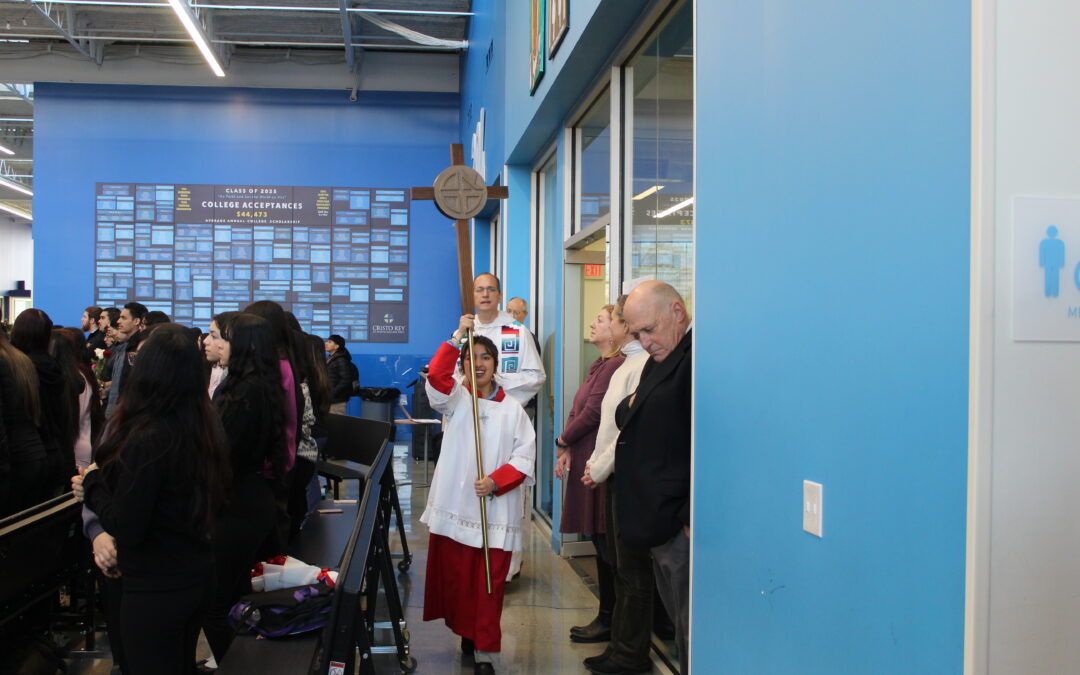
On December 11, 2025, our school community gathered for Mass in a vibrant and moving celebration for the Feast of Our Lady of Guadalupe, honoring a tradition that continues to shape the faith, resilience, and cultural pride of so many of our families.
The celebration was enriched by the presence of Fr. Brendan Curran, OP, a Dominican priest and longtime advocate for immigrant communities. Fr. Brendan is a prominent Chicago faith leader who has been recently featured in national news for his leadership on immigration reform and his work with The Resurrection Project. He offered a reflection on what it means to say yes to compassion, dignity, and justice in today’s world. He reminded us that “God reminds us to say yes even in times of struggle.”
Students also shared heartfelt personal reflections that honored the strength of their families, the importance of cultural and spiritual traditions, and the enduring presence of Our Lady as a source of comfort and protection. Their words grounded the celebration in lived experience and echoed the voices of many who find hope through faith.
As flowers were brought forward in devotion to Our Lady of Guadalupe, the community united in prayer, song, and gratitude, lifting up all who seek belonging, safety, and peace. The celebration concluded with joyful porras in her honor, a reminder that our faith is not only prayed but lived together.
May we continue to embody the spirit of the feast and renew our commitment to love, justice, and saying yes to one another.
by Miranda Eby | Dec 18, 2025 | Academic, School News, Student Life
“Learn, pray, advocate.”
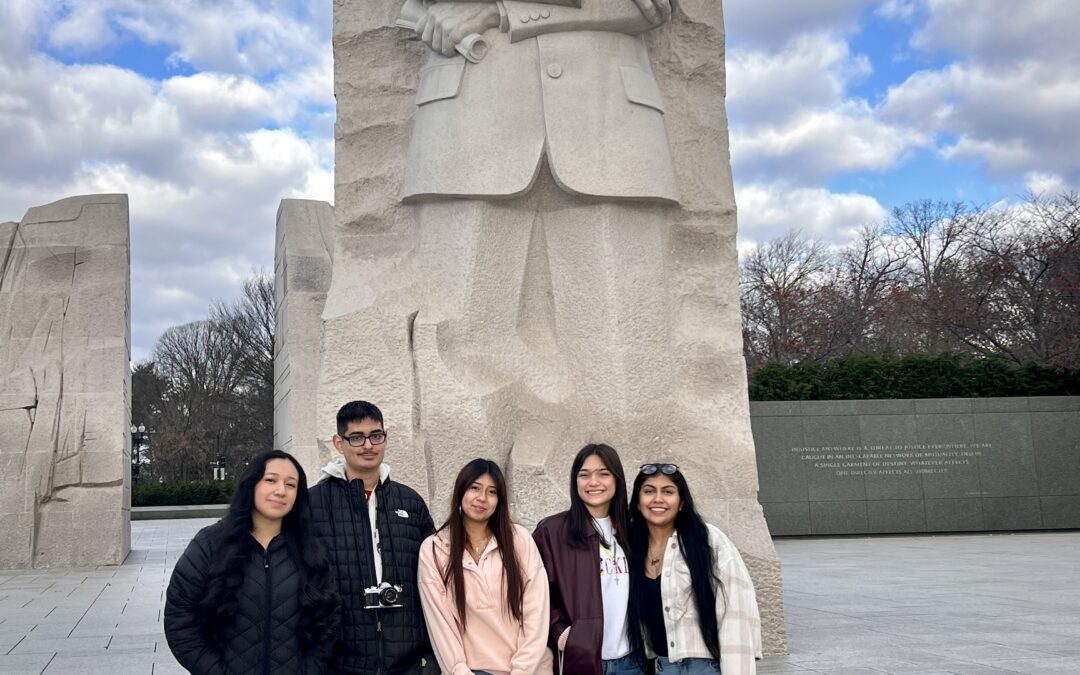
This guiding spirit came alive November 15-17 this year, as five of our upperclassmen traveled to Washington, D.C. to take part in the Ignatian Family Teach-In for Justice (IFTJ). The gathering is a 28-year tradition rooted in honoring the Jesuits and their companions who were martyred in El Salvador. Hosted by the Ignatian Solidarity Network, the Teach-In brings together thousands of students each year to explore the profound connection between faith, justice, and the call to act.
This year’s theme, Pressing On, invited participants to reflect on how hope endures in the face of injustice. For Daniel F., the message resonated deeply. After attending sessions on immigration and on the economic dynamics between the United States and Mexico, he walked away with a renewed sense of purpose. “Pressing on means to have hope. Hope is stubborn and does not give up. We must be stubborn and continue to advocate for ourselves and others.
Itzel P. shared that simply being selected to attend was “a blessing,” and that the experience opened her eyes to the collective power of young people pursuing justice together. Surrounded by a room full of peers passionate about social issues, including immigration and environmental sustainability, she found strength in the Teach-In’s reminder that representation matters. She reflected, “Hope is very stubborn. Regardless of how we look or what labels people give us, we are what God intended us to be.”
For Claudia G., the Teach-In provided a deeply personal connection to her own family story. As the daughter of Mexican immigrants, she found clarity and affirmation in hearing the testimonies of others who had crossed borders in search of opportunity. “After hearing the unique stories of individuals who immigrated in a similar manner to my parents, I understood more fully the emotional and challenging aspects of leaving the country that carried my ancestors’ blood,” she shared. The experience strengthened her commitment to advocate for immigration and refugee justice, “because immigrants are people, and they must be treated like it.”
We are grateful to Mr. Taus for accompanying our students on this transformative journey and for helping them bring these lessons back to our school community. Their reflections remind us that hope, persistent and rooted in faith, compels us not only to press on but to lift others with us.
by Miranda Eby | Dec 18, 2025 | Campus Ministry, School News, Student Life
Each year, CRSM students embody our mission of being people for others by serving throughout our local community. So far this school year, students have completed over 530 hours of volunteer service through Campus Ministry’s outreach programs, partnering with local organizations that make a positive impact every day.
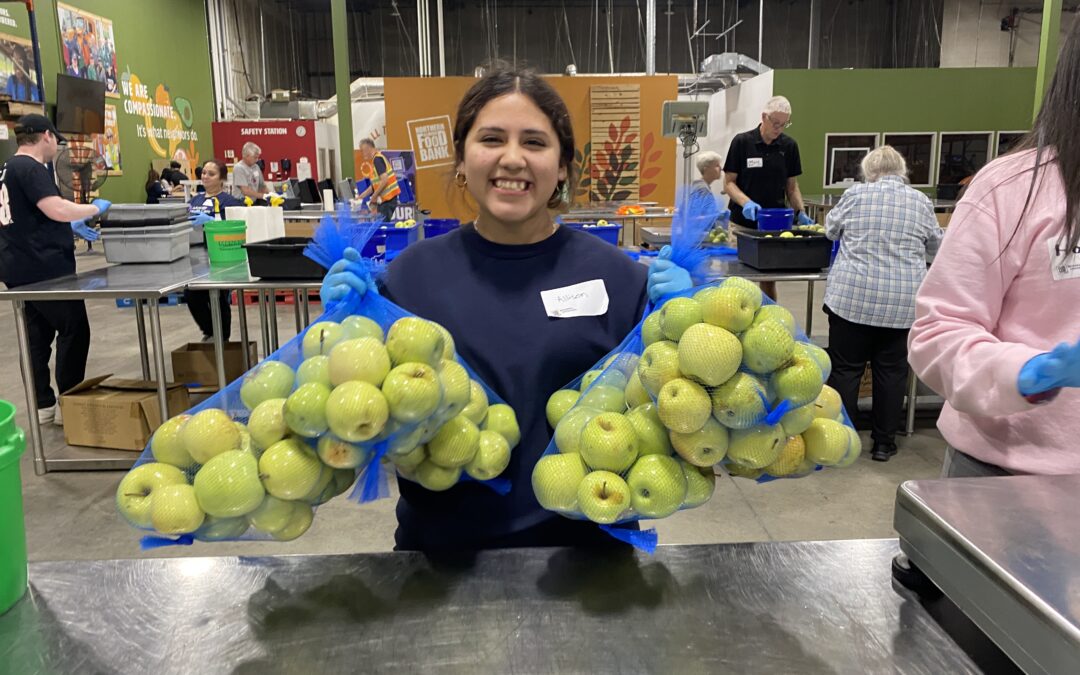
Students volunteer weekly or monthly at St. Anastasia’s Soup Kitchen, Big Brothers Big Sisters at Glen Flora Elementary School, the Northern Illinois Food Bank, and Feed My Starving Children, among several other community partners. Many students also dedicate their weekends to additional service projects with local nonprofits and parish communities.
One of the highlights of the fall semester was the Holiday Meal Distribution hosted at CRSM on November 6. More than 75 students and staff came together to support over 750 families in our community. The event showcased the generosity, teamwork, and commitment to service that define the CRSM spirit.
For many of our students, these volunteer experiences are transformative and go far beyond required service hours.
Alejandra L. (Class of 2027) volunteers monthly at St. Anastasia’s Soup Kitchen. She shared that the experience brings her joy and a sense of connection. “It’s something I look forward to,” she said. “Serving meals and seeing people smile makes me feel connected to something bigger.”
Allison S. (Class of 2027) volunteers regularly at several sites and often serves two or three times a week. “I volunteer because I feel called to serve others,” she said. “Being able to see others be happy when serving them, maybe their first hot meal of the day, shows that small actions can make a huge difference. Even a smile or small talk while pouring food can brighten someone’s day, and that has a big impact on me.”
Allison also reflected on finding time for service. “As Father Corey reminded us at our first Mass this year, we will always be busy, but there is always time to help others.”
Through every act of service, both large and small, CRSM students continue to strengthen the bonds between our school and the wider community. Their work is a reminder that compassion, commitment, and faith in action are at the heart of who we are.
by Miranda Eby | Dec 18, 2025 | CWSP, School News
For more than 20 years, Baxter International has remained a valued and engaged Corporate Work Study partner, providing students with meaningful workplace opportunities that support both their academic and professional growth. As one of our founding partners, Baxter has played an important role in shaping the experience and impact of the Corporate Work Study Program.
Reflecting on their longstanding involvement, Andrea Cherubini, Manager of Corporate Responsibility and Global Philanthropy at Baxter, shared that the company has had “an amazing and positive experience with Cristo Rey students over the years.” She noted that our students “bring enthusiasm, professionalism, and a strong willingness to learn,” and that they “contribute meaningfully to daily operations, assist with both short-term and longer-term projects, administrative tasks, and provide fresh perspectives.”
Andrea added that Baxter employees benefit as well. Mentoring students “creates a rewarding experience for all,” fosters purpose among staff, and strengthens company culture.
At the start of the 2025–26 school year, Baxter welcomed four additional students, bringing their total to ten. In January 2026, they will welcome two more students in their IT department, bringing the total number of Baxter student workers to twelve.
Since 2014, 33 CRSM students have gained experience at Baxter. Fourteen are current students, nine are in college, and five have earned their bachelor’s degrees or higher. Many of these alumni have gone on to successful careers and educational journeys, shaped in part by the early professional exposure Baxter provided.
When asked about the value of the program, Andrea emphasized that participation “provides early exposure to motivated students who may become future employees.” The opportunity also “boosts morale and strengthens company culture,” while aligning with Baxter’s corporate values and commitment to education and social responsibility.
For students, she noted, the Corporate Work Study Program “provides real-world experience with hands-on exposure to professional environments, building confidence and workplace skills.” It also expands their networks, helps them understand potential career paths, and supports their ability to fund their education while preparing for college and future careers.
We are grateful for Baxter’s continued partnership and for the meaningful opportunities they provide to our students. Their commitment helps create pathways, connections, and experiences that last well beyond a single workday, shaping the future of every student who walks through their doors.

by Miranda Eby | Dec 18, 2025 | Development, School News
For longtime Cristo Rey St. Martin supporters Justin and Erin Foley, giving back has always been about creating lasting, generational change. Their journey with CRSM began years ago through friendships and faith, and has grown into a deep, personal commitment to transforming lives through education.
“We first heard about Cristo Rey through our parish, St. Mary’s,” recalls Erin. “It was something that was on our radar, but once I visited the old school, I knew I wanted to get involved.”
At that time, Cristo Rey St. Martin was still operating in its old, aging facility. It was a place where the school’s spirit shone bright despite serious challenges. “There were lockdowns due to shootings in the neighborhood,” Erin remembers. “The building itself wasn’t safe. Chair legs were literally going through the floor. Yet, even then, there was something magical happening there.”
Not long after that visit, the Foleys became active supporters, and Erin joined the school’s Board of Trustees, serving for eight years. During this time, she also spent many years on the CRSM event planning committee. Her leadership and creativity on the committee played an important role in elevating the school’s events and expanding their impact during key moments of growth.
Through Justin’s firm, the Gelber Group, the couple has continued to support Cristo Rey St. Martin’s mission both personally and professionally. “Every time Erin came home from a board meeting, she had stories about the students, their drive, their hope, their determination. That is what kept us invested,” Justin says.
They were involved long before the move to the new Waukegan campus, at a time when a new school was still only a dream. “To see where the school is now, compared to where it started, is incredible,” Justin reflects. “It is proof that this model works. Cristo Rey changes lives, not only for students but also for their families and communities.”
Justin also notes that sustaining the model is more important than ever. “The Corporate Work Study Program was once the main source of funding, but that is no longer the case,” he explains. “Individual giving and annual support have become essential. The mission still works. It simply needs all of us behind it.”
For Erin, the reason to stay involved remains clear. “There are so many ways to help people,” she says. “But education, especially for students who might not otherwise have access, is the most powerful way to make real, generational change. It changes everything for siblings, for parents, and for entire communities.”
The Foleys’ belief in education’s ripple effect has guided much of their philanthropy. Justin also serves on the board for the Daniel Murphy Scholarship Fund, continuing his work to open doors for young people. “When a student experiences success, they often turn around and help the next generation,” he says. “That is how transformation happens.”
From the early, humble beginnings of Cristo Rey St. Martin to the thriving, state-of-the-art campus that stands today, the Foleys have witnessed and supported a story of hope, resilience, and faith in what is possible.
“It is about showing these kids what they can become,” Justin says. “When you invest in education, you are investing in the future of entire communities. That is something we will always stand behind.”